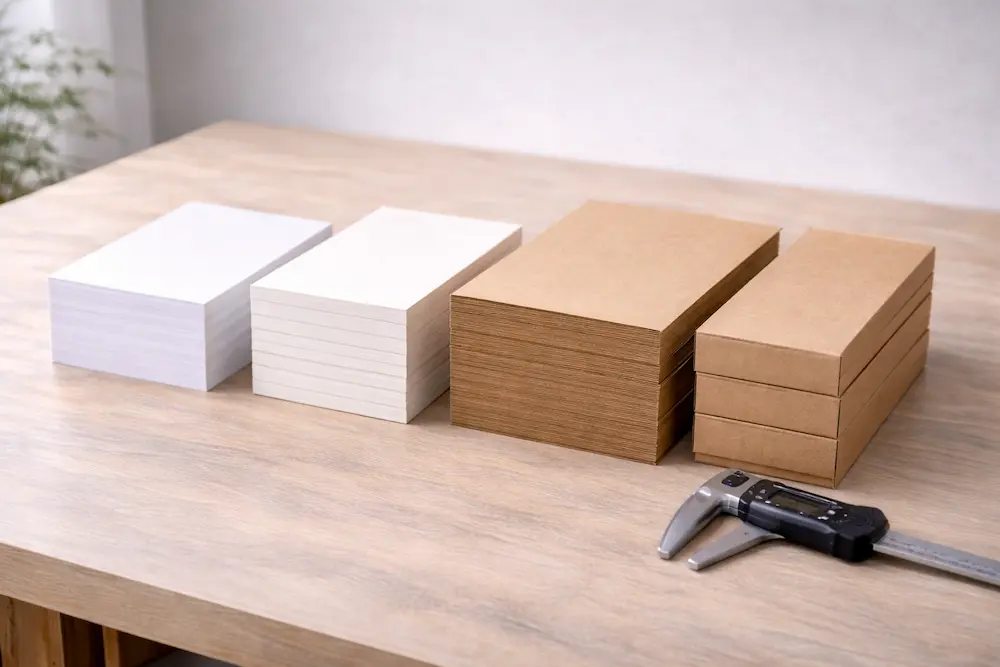
When you’re selecting the best material for your product, understanding how paper weight and thickness work is crucial. One system measures weight (GSM), and another measures thickness (PT). In this article, you’ll discover how each unit works, when to use them and why they matter. By the end, you’ll be better equipped to choose the right packaging—and know when to ask Pakoro for expert help.
What Do GSM and PT Stand For?

Before diving deeper, it’s worth clarifying the names. GSM (grams per square meter) describes the weight of a paper sheet one meter square. PT (point system) refers to the thickness of paper measured in points. One point equals 0.001 inches. Both units help you understand the density and rigidity of packaging, but they measure different attributes.
You might notice different regions favour one system over the other. For example, GSM is popular globally, while PT is common in North America. However, professionals often convert between them depending on client requirements.
GSM: Weighing Your Paper Options

GSM is the metric system’s way of determining paper weight. Imagine picking up two sheets of the same size; one feels thicker because it weighs more. That’s what GSM captures—the mass per area. The higher the number, the heavier (and usually thicker) the sheet.
Understanding common GSM ranges can help you visualise different materials:
- 35–55 GSM – very light; used in newspapers or fragile tissues.
- 90–100 GSM – standard printer paper.
- 120–140 GSM – typical for posters and bulletins.
- 210–300 GSM – used for magazine covers and heavier leaflets.
- 350–600 GSM – ideal for rigid packaging, invitations and business cards.
Although a higher GSM often corresponds to thicker material, weight alone doesn’t tell you everything about durability. A well‑engineered lightweight board can still resist external damage, so always combine GSM with other factors like fibre composition and coating.
PT: Measuring Thickness Precisely

In the PT system, each point is one‑thousandth of an inch. Manufacturers use a micrometer to measure a sheet’s caliper (its thickness). For example, a 10‑point board is about 0.010 inches thick.
PT values are intuitive when you think about structure. Higher points indicate a thicker board, which typically offers more rigidity. It also influences printing: thicker boards may require specialized equipment. Here’s how PT values align with common use cases:
- 3–6 PT – thin, ideal for newspapers or very lightweight inserts.
- 7 PT – similar to standard printer paper.
- 8 PT – often used for posters and bulletin boards.
- 9–12 PT – typical for magazine covers; balances flexibility and strength.
- 14–22 PT – used for heavy card stock, premium packaging and business cards.
GSM vs PT: Key Differences and How to Convert
Different Properties, Same Goal
GSM and PT both describe how hefty a paper feels, yet they do so differently. GSM measures weight; PT measures thickness. It’s possible to have a high‑GSM sheet that is relatively thin (due to dense fibres) or a lower‑GSM sheet that is thicker because of its structure.
Understanding that distinction helps you decide which metric matters more for your project. If your priority is structural rigidity, PT values may provide clearer guidance. If the mass and feel of the sheet matter more, then GSM is the better metric.

Rough Conversions
Because GSM assesses weight while PT measures caliper, direct conversion isn’t exact. However, industry tables offer approximations. For example:
- 10 PT ≈ 200–230 GSM
- 12 PT ≈ 270–300 GSM
- 14 PT ≈ 310–350 GSM
- 16 PT ≈ 350–400 GSM
- 18–20 PT ≈ 400–460 GSM
Keep in mind these are ballpark figures. Variations arise from paper type, coating, and manufacturing methods. When in doubt, request samples or consult a packaging expert at Pakoro.
The Bigger Picture
Neither GSM nor PT alone should decide your final selection. Both metrics are useful for assessing material, but factors such as fibre type, coating, surface finish and printability can be equally important. Some stocks have smooth surfaces suited for high‑quality printing, while others are rougher but stronger. A complete evaluation will consider visual aesthetics, tactile feel, sustainability and cost.
How to Choose the Right Unit for Your Needs

- Define Your Goal – What does your product need? Lightweight mailers, premium boxes or heavy cartons? Knowing the desired feel guides whether GSM or PT matters more.
- Consider Printing Methods – Certain printing processes require specific thicknesses. Discuss this with your printer or packaging supplier.
- Check Durability Requirements – Evaluate how much handling or transport stress the packaging will endure. Higher PT boards usually provide better structural support.
- Look at Aesthetics and Brand Identity – A smooth, coated surface may print vivid colours better but could weigh more. A textured board might suit an organic brand image but require special inks.
- Ask for Samples – The most reliable way to decide is to examine physical samples. Touching and folding the material will reveal qualities not captured by numbers.
Bringing it All Together with Pakoro
At Pakoro, we know that selecting packaging material can feel overwhelming. You might be wondering whether to rely on GSM, PT or a combination of both. Our advice? Use these units as guides, not rules. Let’s explore materials together so your product stands out, protects its contents and reflects your brand values.
Whenever you’re ready, contact Pakoro through our website or email us at Melody@pakoro.com. We’re always happy to chat and provide tailored recommendations. Your packaging deserves the best, and understanding GSM vs PT is the first step in getting there.
Visual Aids
To help you visualise the difference between paper weight and thickness, here are two abstract illustrations. The left stack shows increasing weight (darker shades); the right stack shows increasing thickness (wider layers). These visuals reinforce the distinction between GSM and PT without text.