China is a practical sourcing market for custom POP displays, especially cardboard floor displays, countertop units, dump bins, PDQ displays and retail-ready corrugated display kits. Buyers should choose a POP display manufacturer based on structural engineering, material strength, print quality, assembly method, quality control and export packing—not only the quoted unit price.
A POP display, or point-of-purchase display, is a branded retail structure placed near shelves, aisles, checkouts or promotional zones to improve product visibility and encourage purchase decisions. Most temporary POP displays are made from printed corrugated board; permanent displays may use metal, wood, acrylic or mixed materials.
What Makes a Reliable POP Display Manufacturer?
A reliable POP display manufacturer should be able to convert a retail brief into a workable display structure, then verify its performance before mass production. Buyers should expect support with dielines, artwork placement, load-bearing design, samples, assembly instructions, master-carton packing and export shipping.
The best supplier for a short seasonal promotion may be different from the best supplier for a permanent cosmetics fixture. Cardboard displays are generally lighter, more economical and easier to recycle, while metal, wood and acrylic displays are better suited to longer retail campaigns or premium in-store environments.
Top 10 POP Display Manufacturers in China
This list is intended as a starting point for supplier research. Buyers should independently verify each company’s current capabilities, certifications, production location, lead time and project fit before issuing a purchase order.
1. Solid Displays
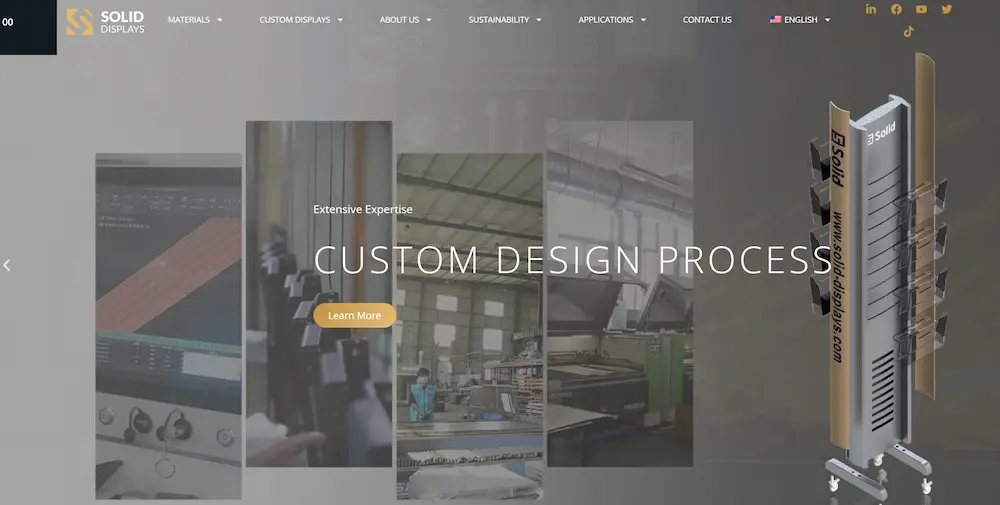
Solid Displays is a retail display and fixture supplier associated with custom point-of-purchase projects. Its product scope includes retail fixtures and mixed-material display structures.
Best fit: Brands requiring metal, wood, acrylic or mixed-material retail fixtures.
Buyer consideration: Ask whether the supplier produces the required material in-house or coordinates subcontracted components. Mixed-material displays can require more complex quality control and longer assembly lead times.
2. Shenzhen Pakoro Packaging Co., Ltd.

PAKORO is a China packaging manufacturer serving global B2B buyers with custom cardboard POP displays, display boxes, corrugated packaging, folding cartons and gift packaging. Its display capability is most relevant for brands seeking printed corrugated retail displays, countertop units, floor displays and promotional packaging projects.
Best fit: Custom cardboard displays, retail campaigns, display boxes and projects requiring coordinated paper packaging.
PAKORO’s custom POP display manufacturing capability includes customizable structures and a stated starting MOQ of 500 units for wholesale custom POP display orders. Buyers can also combine promotional displays with corrugated box manufacturing for outer shippers and retail distribution.
3. Shenzhen WOW Packaging Display Co., Ltd.

Shenzhen WOW Packaging Display is associated with cardboard POP displays and packaging boxes. Its product range includes floor displays, dump bins, sign boards, hook displays and retail display structures.
Best fit: Corrugated retail displays and promotional cardboard display projects.
Buyer consideration: Request a load test or product-weight calculation for floor displays and dump bins. A visually appealing display can fail in-store if shelf spans, dividers or base panels are under-specified.
4. Dongguan POP Display & Packing Co., Ltd.
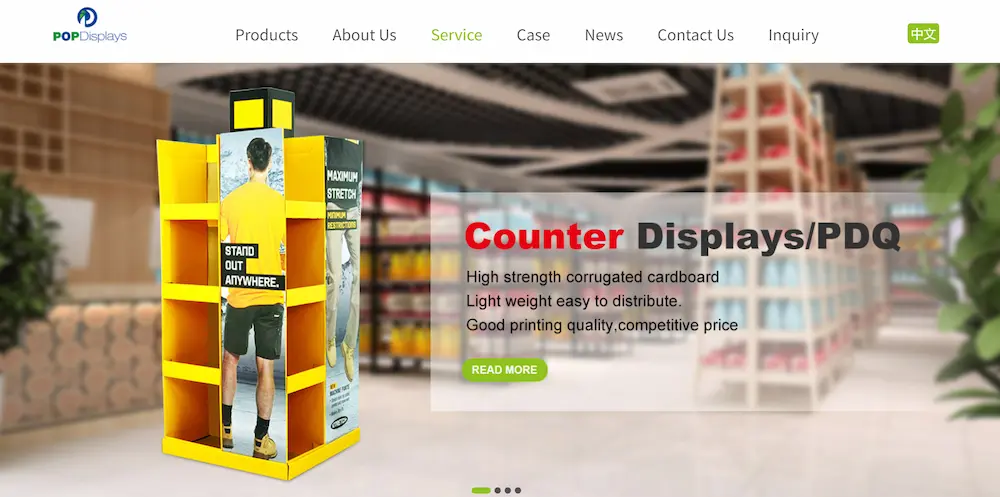
Dongguan POP Display & Packing offers corrugated and cardboard display formats, including PDQ displays, sidekicks, pallet displays and hook displays.
Best fit: Supermarket promotions, product launch displays and corrugated merchandising units.
Buyer consideration: Confirm the retailer’s exact display footprint, aisle restrictions and pallet dimensions before finalizing the dieline. A display that fits one chain’s planogram may not fit another retailer’s store requirements.
5. Leader Display PDTS Co., Ltd.
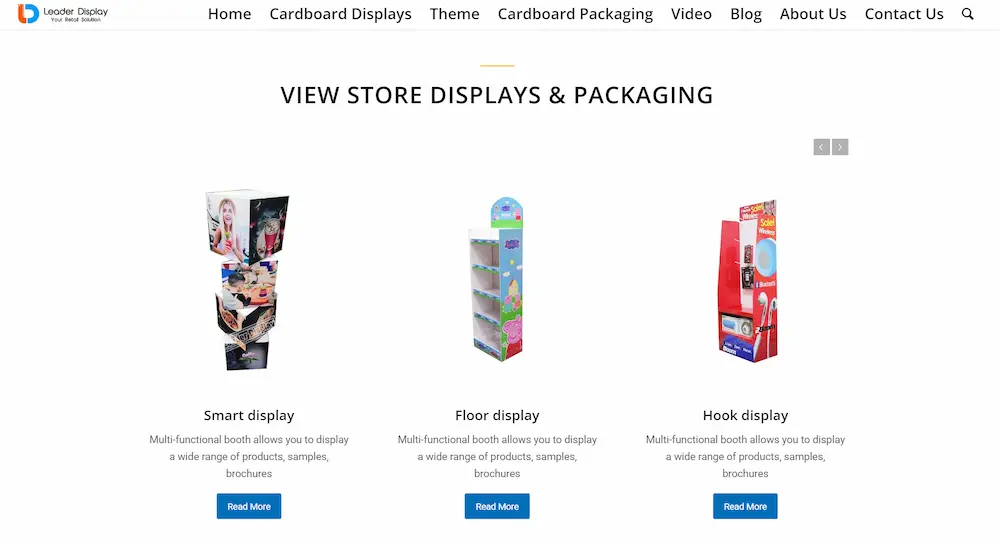
Leader Display PDTS focuses on custom POP display projects for sectors such as cosmetics, food and beverage. It may be relevant for buyers needing design support alongside display production.
Best fit: Counter displays, floor displays and consumer-product promotions.
Buyer consideration: For cosmetics and smaller consumer products, specify the exact product count per shelf, the product’s centre of gravity and any anti-theft requirements. These details influence shelf depth, tray angle and structural reinforcement.
6. Kee Displays
Kee Displays offers POP, POS and kiosk display solutions in materials including acrylic, metal, wood and cardboard. It is relevant for buyers considering both temporary and longer-term display formats.
Best fit: Mixed-material displays, retail fixtures and projects requiring kitting.
Buyer consideration: Ask how the supplier packs separate components and whether the display can be shipped flat-packed. Flat-packed displays usually reduce freight volume but must be simple enough for retail staff to assemble correctly.
7. Shanghai Shiquan Display Products Co., Ltd.
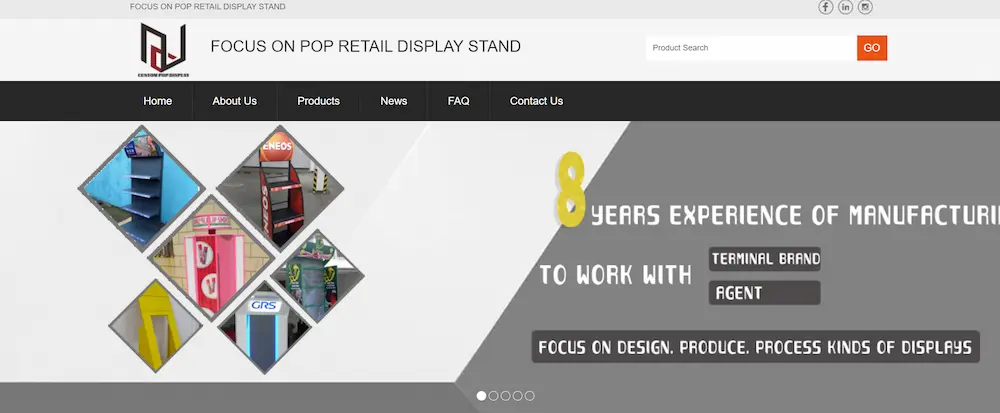
Shanghai Shiquan Display Products produces custom retail display structures, including floor displays, countertop displays, acrylic displays and wood fixtures.
Best fit: Custom retail programs with a broad material requirement.
Buyer consideration: Request a clear sample approval process. For multi-material displays, the approved sample should confirm not only graphics but also surface finishing, hardware, colour consistency, edge treatment and final assembly.
8. Kunshan Deco POP Display Co., Ltd.
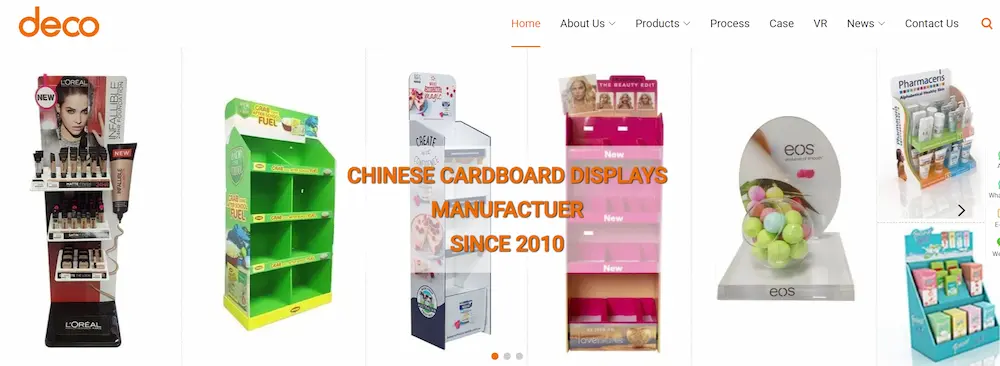
Kunshan Deco POP Display is associated with printed cardboard and acrylic displays for retail and supermarket projects, including floor stands, counter displays and pallet displays.
Best fit: Paper-based promotional displays and supermarket merchandising.
Buyer consideration: Confirm whether the final display will be delivered pre-assembled, partially assembled or fully flat-packed. This affects labour cost at destination, carton dimensions and risk of damage during shipping.
9. Shenzhen Topwon Group Co., Ltd.

Shenzhen Topwon Group focuses on custom corrugated displays, including brochure stands, counter racks and large floor-display formats.
Best fit: Higher-volume corrugated display campaigns and seasonal retail promotions.
Buyer consideration: Large displays should be designed around the product load and delivery route. Request details on board grade, flute type, reinforcement panels and master-carton packing rather than approving a design based only on a 3D rendering.
10. HICON POP Displays Ltd
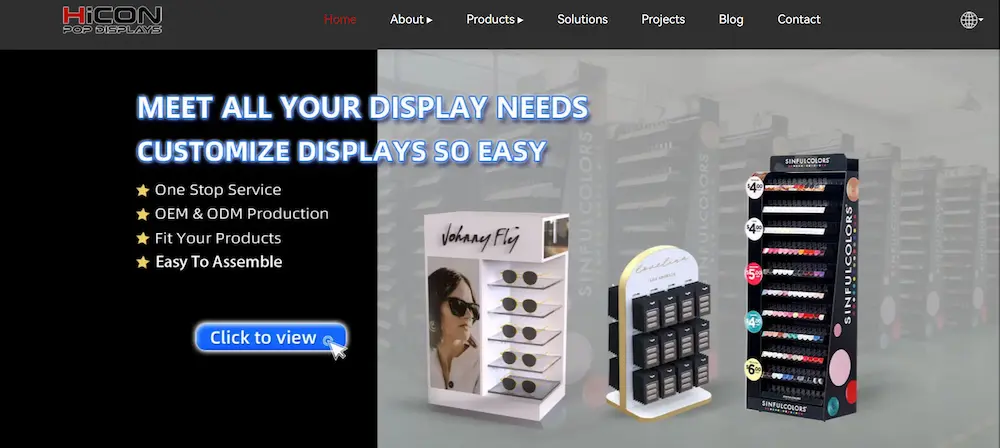
HICON POP Displays produces retail fixtures and displays in materials such as metal, wood, acrylic and cardboard. It is relevant for buyers sourcing longer-lasting retail fixtures or complex multi-material structures.
Best fit: Permanent fixtures, branded shop-in-shop displays and multi-material retail projects.
Buyer consideration: Permanent displays require more attention to finishing durability, hardware, freight protection and replacement-part planning than temporary corrugated displays.
POP Display Types Compared
| Display Type | Best Use | Typical Material | Main Buyer Concern |
|---|---|---|---|
| Counter display | Checkout and shelf promotion | E-flute corrugated board, paperboard | Compact footprint and product access |
| Floor display | New-product launch or aisle promotion | B-flute or EB-flute corrugated board | Load capacity and base stability |
| Dump bin | High-volume promotional products | Corrugated board | Product weight and bin reinforcement |
| PDQ display | Retail-ready shelf placement | Corrugated board | Retailer dimensions and fast setup |
| Pallet display | Warehouse club and supermarket promotions | Heavy corrugated board | Pallet compatibility and transport strength |
| Permanent fixture | Longer retail installations | Metal, wood, acrylic | Durability, hardware and assembly |
Manufacturing Insight: Corrugated POP Display Materials
Corrugated board is the most common material for temporary POP displays because it can be printed, die-cut, shipped flat and assembled quickly.
E-flute is thinner and smoother, making it suitable for countertop displays, trays and detailed retail graphics. B-flute offers stronger compression resistance and is commonly used for floor displays. EB-flute combines a printable outer surface with additional strength and is often chosen for displays carrying heavier products.
A display’s strength is determined by more than flute type. Shelf span, product weight, load distribution, base design, internal supports, locking tabs and moisture exposure all affect real in-store performance.
For retail projects requiring a carton as well as a display, PAKORO can coordinate custom packaging manufacturing with POP display production so the product carton, display graphics and transit packaging use a consistent visual system.
MOQ, Samples and Lead Time
Typical MOQ for custom cardboard POP displays often starts around 500 units, depending on the structure, size, printing method and material. Small countertop displays may be feasible at lower quantities than large floor displays because tooling and board consumption are lower.
A plain structural sample commonly takes around 3–7 working days after the dieline is confirmed. A finished pre-production sample can take longer if the project includes lamination, foil stamping, special coatings or complex assembly.
Mass production commonly takes 15–30 days after sample approval. Buyers should also allow time for export packing, container booking and freight transit. For retailer deadlines, it is wise to set an internal deadline for sample approval rather than waiting until the final shipping date.
What Affects POP Display Cost?
The main cost factors include:
- Display dimensions and board area
- Corrugated flute type and board grade
- Product weight and structural reinforcements
- Number of shelves, dividers, hooks or accessories
- Printing coverage and finishing
- Die-cut complexity and assembly labour
- Flat-packed versus pre-assembled shipping
- Master-carton requirements and freight volume
- Order quantity and destination market
A common mistake is selecting the lowest-cost board without evaluating its performance under product load. A weak display can collapse, lean or lose its shelf shape in a retail environment, creating a cost far greater than the initial material saving.
Quality Control for Custom POP Displays
Each POP display order should go through structural, visual and packing checks before shipment.
Key checks include:
- Correct display dimensions and shelf positions
- Board grade and flute direction
- Print colour and artwork placement
- Die-cut accuracy and clean fold lines
- Tab, slot and glue performance
- Assembly time and assembly instructions
- Shelf-load and stability testing
- Correct product count per display
- Master-carton strength and shipping marks
At PAKORO, Shenzhen Pakoro Packaging Co., Ltd., display projects are reviewed around structure, material, print specification, packing method and export requirements. This approach helps buyers identify risks before mass production rather than after displays arrive at a retailer.
How to Choose a POP Display Manufacturer in China
When choosing a supplier, buyers should provide a clear brief containing:
- Product dimensions, unit weight and quantity per display
- Retailer or store footprint requirements
- Target display type and campaign duration
- Artwork, brand guidelines and required finishes
- Required assembly method
- Destination country and shipping preference
- Required delivery date
- Expected order quantity
The strongest supplier will ask practical questions about load, assembly, retailer requirements and packing. Be cautious if a supplier quotes immediately without confirming product weight, display dimensions or shipment requirements.
FAQ
1. What is a POP display?
A POP display is a point-of-purchase display used in retail stores to make products more visible and easier to buy. It may be placed on a counter, shelf, aisle, checkout area or pallet. POP displays are commonly made from printed corrugated board for short-term promotions, while permanent retail displays often use metal, wood, acrylic or a combination of materials.
2. What is the MOQ for custom cardboard POP displays?
The MOQ for custom cardboard POP displays is often around 500 units, but the final quantity depends on display size, material, printing and structural complexity. Small countertop displays can sometimes use a lower MOQ than large floor displays. Buyers should request a quotation based on the exact dieline and product load because a generic MOQ does not account for tooling or board consumption.
3. How long does POP display production take?
Custom POP display production commonly takes 15–30 days after sample approval. The process includes structural engineering, material confirmation, printing, die-cutting, assembly or kitting, quality inspection and export packing. Simple countertop displays may move faster, while large floor displays with special finishes or mixed materials can take longer. Buyers should also include time for sampling and international shipping.
4. Which material is best for a cardboard floor display?
B-flute or EB-flute corrugated board is often suitable for cardboard floor displays because it provides better strength than thin paperboard. The correct choice still depends on product weight, shelf width, display height and retailer environment. A display carrying glass bottles, cosmetics or heavy multipacks may need reinforced shelves, double-wall board or internal support panels in addition to the selected flute type.
5. Can POP displays be shipped flat-packed?
Yes, most cardboard POP displays can be shipped flat-packed to reduce freight volume and protect the structure during transport. However, the design must use clear locking tabs, simple assembly steps and well-organized components. Buyers should ask for assembly instructions and a video or sample assembly test. A flat-packed display is only cost-effective when store staff can assemble it correctly and quickly.
6. What factors affect the cost of a POP display?
POP display cost is affected by size, board grade, flute type, printing, finishing, structural complexity, assembly labour and shipping volume. Reinforced shelves, trays, hooks, pallets and special finishes can increase the cost. Freight is also important because displays can occupy significant volume. Buyers should compare total landed cost, including master cartons and freight, instead of only comparing factory unit prices.
7. How do I test whether a display is strong enough?
A display should be tested using the actual product weight and the expected quantity per shelf or bin. Ask the manufacturer to confirm the board grade, shelf support method, base construction and load test approach. A physical sample is the best way to assess stability. Buyers should also consider transport vibration, retail handling and humidity, because these conditions can reduce corrugated-board performance.
8. What is the difference between POP and POS displays?
POP means point of purchase, while POS means point of sale. In practice, the terms are often used interchangeably for branded retail display units. Some buyers use POP for promotional displays positioned near products and POS for checkout-area merchandising. The more important distinction is the display’s function: whether it is intended for shelf promotion, aisle placement, checkout sales or a permanent retail fixture.
9. Can a China POP display manufacturer provide samples?
Yes, most experienced manufacturers can provide structural samples, white samples or finished pre-production samples. A white sample checks size, assembly and product fit. A finished sample checks printing, colour and finishing. For floor displays and dump bins, buyers should request a loaded sample test using real products. Never approve a large retail display solely from a digital rendering or flat artwork file.
10. How should POP displays be packed for export?
POP displays should be packed according to whether they are shipped flat, partially assembled or fully assembled. Flat-packed components require protective layers, clear component separation and strong master cartons. Pre-assembled displays need corner protection and void fill to prevent crushing. Buyers should request outer-carton dimensions, gross weight, stacking guidance and loading quantities before choosing sea, air or consolidated freight.