You sell great products, so you need paper bags that won’t quit. As your packaging partner at Pakoro, I’ll walk you through every stage — in plain English and with practical tips you can apply right away. Ready? Let’s dive in.
Quick-Glance Cheat Sheet — How Paper Bags Are Made
| What you’re asking | Fast answer you can act on today |
|---|---|
| Core material | Kraft or recycled paper, both from cellulose fibre |
| Six manufacturing steps | 1) Choose pulp → 2) Pulp & bleach → 3) Make paper → 4) Form bags → 5) Print & finish → 6) Quality-check |
| Top bag styles | Flat, satchel (side-gusset), block-bottom |
| Eco-disposal | Re-use first, then recycle or compost; avoid landfill whenever possible |
Use this table in your next team meeting. It covers 80 % of the questions buyers ask about paper bag manufacturing.
1. What Are Paper Bags Made Out Of?
You can’t build a strong bag without strong paper.
Most suppliers rely on kraft paper because it offers high tear resistance. When sustainability matters more, you can shift to 100 % recycled paper. If your brand needs extra gloss or water resistance, a specialty coated sheet steps in.

Key factors you should weigh
- Cost per tonne
- Burst strength (lab data beats guesses)
- Environmental scorecard (FSC, recycled content, carbon footprint)
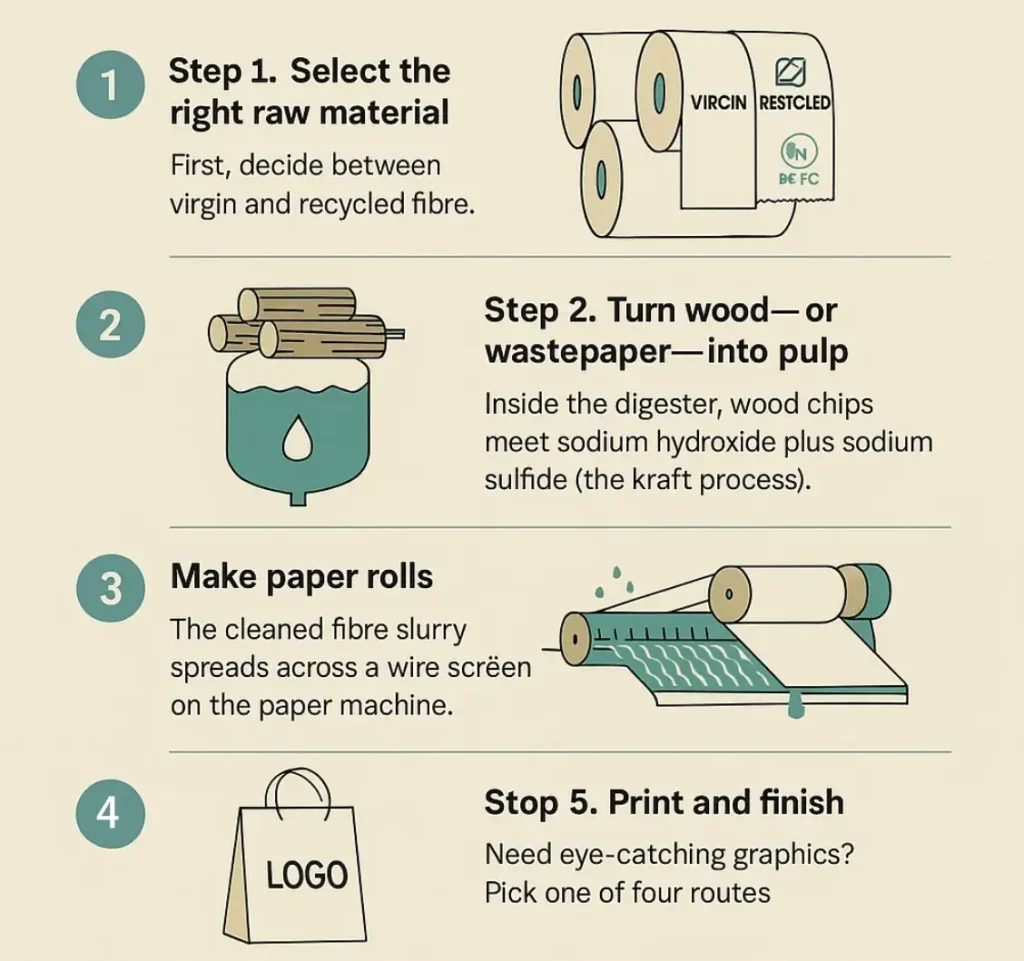
2. How Paper Bag Manufacturing Works — 4 Essential Steps
3. The Chemistry Behind Strong, Safe Paper Bags
Why should you care about chemistry? Because it affects odour, recyclability, and even food safety.
- Kraft pulping yields the strongest fibres — ideal for grocery loads.
- Bleaching with chlorine dioxide or hydrogen peroxide brightens the sheet without leaving harmful chlorinated compounds.
- Sizing agents like AKD boost water resistance, so your bag survives a rainy walk to the car.
- Trace biocides keep mould at bay during ocean freight.
Ask your mill for a complete chemical disclosure to stay ahead of evolving regulations.
4. How to Dispose of Paper Bags Responsibly
You already know recycling matters, yet many bags still end up in landfill. Here’s a quick disposal roadmap you can share with customers:
- Reuse — each bag averages three trips before fibres weaken.
- Recycle — remove plastic windows first. Most curbside systems accept clean kraft.
- Compost — uncoated bags break down in 90 days in industrial composters.
- Energy recovery — your last resort; it creates heat but also CO₂.
Add a one-line reminder inside the gusset — you’ll boost recycling rates by up to 15 %.
5. Common Manufacturing Problems and How You Can Prevent Them
| Pain point | Why it happens | Your fast fix |
|---|---|---|
| Paper tears during folding | Moisture too low | Store rolls at 50 – 60 % RH |
| Glue failure | Wrong viscosity or nozzle clog | Run daily glue-pot checks |
| Print mis-register | Plate mount slippage | Switch to sticky-back polymer plates |
| Machine downtime | Worn knives or belts | Adopt predictive maintenance sensors |
Remember: every hour a bag machine sits idle can cost hundreds in lost output. Preventive action keeps orders on schedule.
6. Should You Buy From a Manufacturer or a Vendor?
- Lower unit cost
- Wider custom options
- Higher minimums and longer lead times
Through a vendor or distributor
- Smaller MOQs
- One-stop catalogue convenience
- Added margin, less production insight
Hybrid solution
Join a buying cooperative, or partner with Pakoro to bundle your volumes with other clients. You secure factory pricing without committing to thousands of cartons at once. Curious? Talk to our team today.
Conclusion — Turn Knowledge Into Action
Now you understand how paper bags are made from tree to till. You’ve seen the chemistry, the machinery, and the sustainability path. Use this insight to choose the right material, control quality, and guide customers toward responsible disposal.
When you’re ready to level-up your bag program — from kraft bread sleeves to luxury block-bottom totes — Pakoro is here to help. Explore our full capabilities at pakoro.com or drop us a line through our contact page. Let’s build packaging that carries your brand further and leaves the planet better.